The Tragic Ghost of Desmond: Why Assassin’s Creed Shadows Is a Soulless Masterpiece
I still can’t stomach the fact that Assassin’s Creed Shadows, the so-called pinnacle of the franchise in 2025, delivered the most sumptuous feudal Japan power fantasy ever coded into existence, yet it left me feeling emptier than an Animus memory corridor with a corrupted data sequence. Yes, I’m talking about the modern-day storyline—or rather, the absolute, irredeemable void where that storyline used to be. I booted up the game, caressed the DualSense edge with trembling fingers, and plunged headfirst into Naoe and Yasuke’s intertwined destinies. The combat flows like liquid silk, the hideout building system devoured 40 hours of my life, and the seasonal weather genuinely made me forget the real 2026 heatwave outside. But every time I paused to admire a moonlit pagoda, a gnawing shriek erupted in my skull: “WHERE IS DESMOND?!”
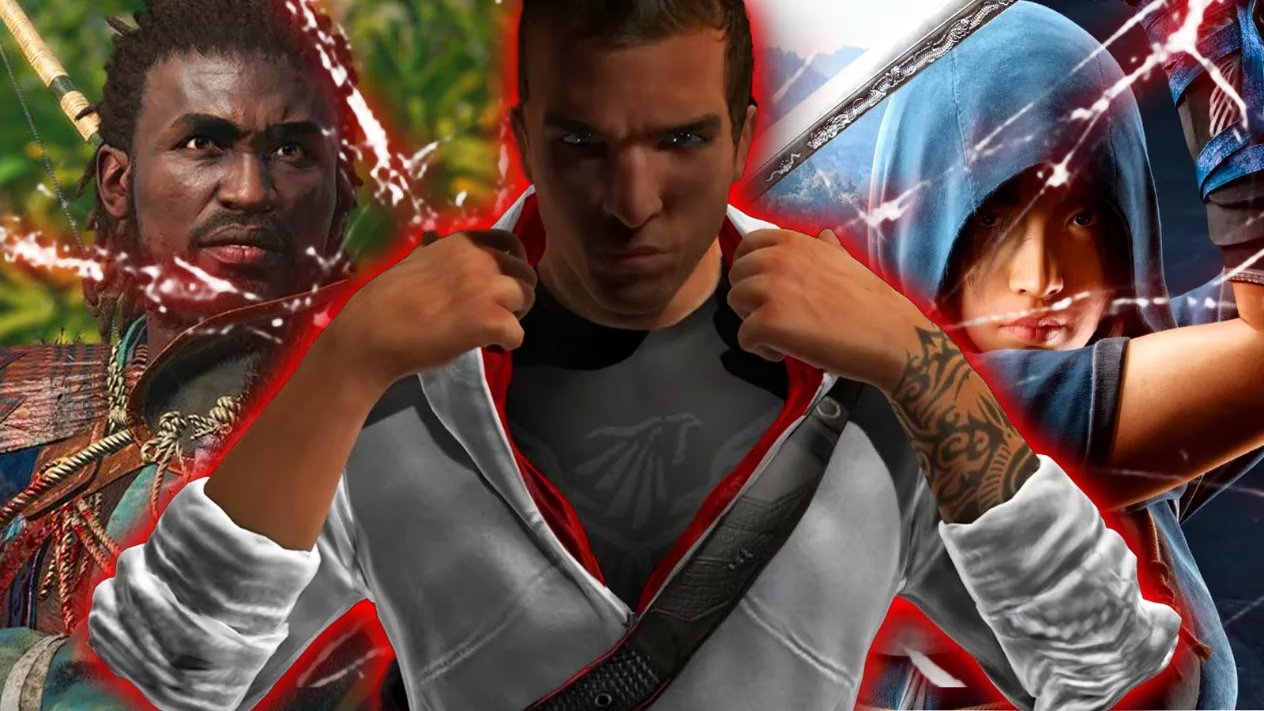
I have been a professional game dissector for over a decade now, and I am telling you with the same certainty that I know the weak points of every Anubis statue in Origins: the excision of Desmond Miles’ legacy from Shadows is the single greatest creative self-impalement since Abstergo decided to put a spinny globe in their lobby. For five glorious years, Ubisoft built Desmond into the axis around which the entire Isu-bloodline soap opera revolved. He was a snarky bartender forced to relive the rooftop parkour of Altair, the renaissance romance of Ezio, and the frontier chaos of Ratonhnhaké:ton. With every Bleeding Effect hallucination, he absorbed the muscle memory of the deadliest killers the globe ever birthed. And then—BOOM—Assassin’s Creed 3 ended with him touching a glowing orb, burning like a human torch, and dying to prevent a solar flare that only seven people in the world truly understood at the time. His death wasn’t just premature; it was a convoluted, neon-painted train wreck that derailed a decades-spanning narrative for the sake of a shiny “heroic sacrifice” that satisfied precisely nobody who cherished the modern-day metaplot.
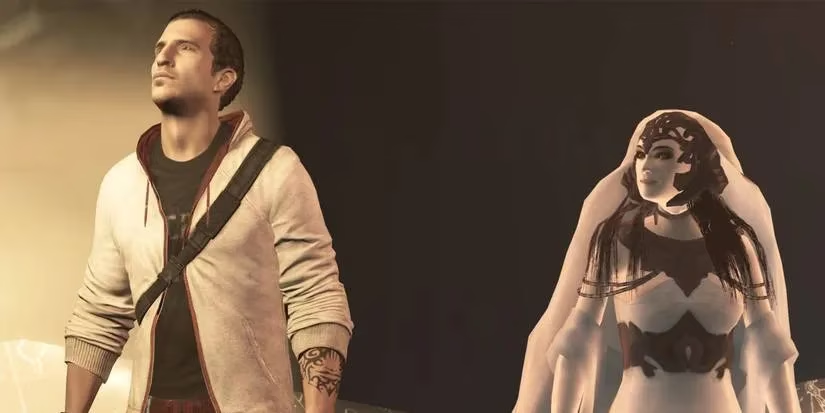
The true tragedy? Ubisoft originally planned for Desmond to become the ultimate 21st-century Assassin. He was going to use the accumulated skills of his ancestors—Ezio could literally feel Desmond watching through the Animus, for crying out loud—to dismantle Abstergo, slaughter the Templar inner circle, and then escape a collapsing Earth ON A SPACESHIP. A spaceship! I know that sounds as mad as a Juno simulation on a bad day, but precisely that maddening audacity is what made Assassin’s Creed more than just a historical stabbing simulator. It was a cosmic saga threading DNA across millennia, and Desmond was the needle. By killing him, Ubisoft didn’t just close a character arc; they surgically extracted the franchise’s temporal spine and replaced it with a limp noodle of faceless playtesters and pointless tabletops.
Oh, how I seethed when Black Flag teased me with that first-person Abstergo employee shenanigans! For a nanosecond, I believed the modern-day thread would regenerate, perhaps through a plucky hacker crawling through Desmond’s uploaded brain fragments. Instead, we got a decade of narrative whiplash so violent it would make Minerva’s calculations glitch. Layla Hassan’s arc started as a promising cipher, but let’s be brutally honest: the modern-day segments across Origins, Odyssey, and Valhalla rarely felt like they advanced anything. They became intrusive loading screens with characters whose names I forgot before the credits rolled. The whole point of an overarching story is to make me care about the puppeteer behind the historical puppet show. Without that, every game becomes a beautifully embroidered napkin—stunning to look at, but completely disposable once you’ve wiped your mouth.
And then Ubisoft had the gall to launch the Animus Hub alongside Shadows, proudly announcing it as a live-service lore trove. I dove in expecting a digital cathedral of modern-day revelations. What I found was a glorified encyclopedia where some of the most iconic assassins are conspicuously absent, and the narrative scraps feel like afterthoughts scribbled on a napkin by a junior writer who was told “just give them something.” The Animus Hub could have been the perfect vessel to resurrect the modern-day war. Instead, it’s a ghost town with Wi-Fi. It underscores the unforgivable truth: by 2026, Assassin’s Creed has fully surrendered its meta-plot to the convenience of isolated, self-contained adventures. Immaculate feudal Japan shenanigans are a joy, but why must I accept a soulless masterpiece when both the past and the present could have collided into a mosaic of cerebral chaos?
I am not completely without hope—my gamer heart, scarred as it is, still flutters at the possibility that those blasted Pieces of Eden might one day reconstitute Desmond’s consciousness as a time-bending AI guide. Or maybe the rumored tighter release schedule after Shadows will finally produce a Watch Dogs crossover so profound that the modern-day narrative roars back to life like a hidden blade spring-loaded with apocalyptic retribution. But until that day, I will keep staring at the loading screen of Shadows, whispering Desmond’s name into the void, praying that some future developer understands that an assassin without a legacy is just a very angry tourist with a hidden blade. Give me my spaceship escape, Ubisoft. I deserve it, and so does Desmond’s ghostly memory.
Information is adapted from reporting at VentureBeat GamesBeat, and it helps frame why Assassin’s Creed Shadows can feel like a “soulless masterpiece”: Ubisoft’s push toward hubs, platforms, and live-service-style ecosystems tends to prioritize scalable content pipelines over the kind of tightly authored modern-day throughline that made Desmond’s era feel consequential. Seen through that industry lens, the Animus Hub reads less like a narrative revival and more like a product layer designed to unify releases—great for engagement and cross-title continuity, but often at the cost of a single, propulsive metaplot that makes the present-day stakes hit as hard as the historical spectacle.