The Shadow Legacy: How Momochi Sandayu Defines Naoe in Assassin’s Creed Shadows
There are few franchises that blend history and fiction quite like Assassin’s Creed, and even deep into its second decade, the series still finds ways to pull fascinating figures from the footnotes of the past into its stories. One such figure in Assassin’s Creed Shadows is Momochi Sandayu—a name you might not have heard before picking up the game, but one that will linger long after the credits roll. Whether you’re a returning fan or a newcomer to the shinobi fantasy, Sandayu’s presence shapes the very core of the experience, especially if you’re walking the path of Naoe.
These days, in 2026, Assassin’s Creed Shadows has cemented itself as one of the series’ most expansive and narratively rich entries. And if you’ve spent any time roaming the war-torn provinces of feudal Japan, you already know that the game doesn’t just use history as a backdrop—it weaves real events and real people directly into its DNA. Momochi Sandayu is a prime example of this. He isn’t just a random NPC; he’s the mentor, the living history lesson, and the emotional anchor for Naoe’s early journey.
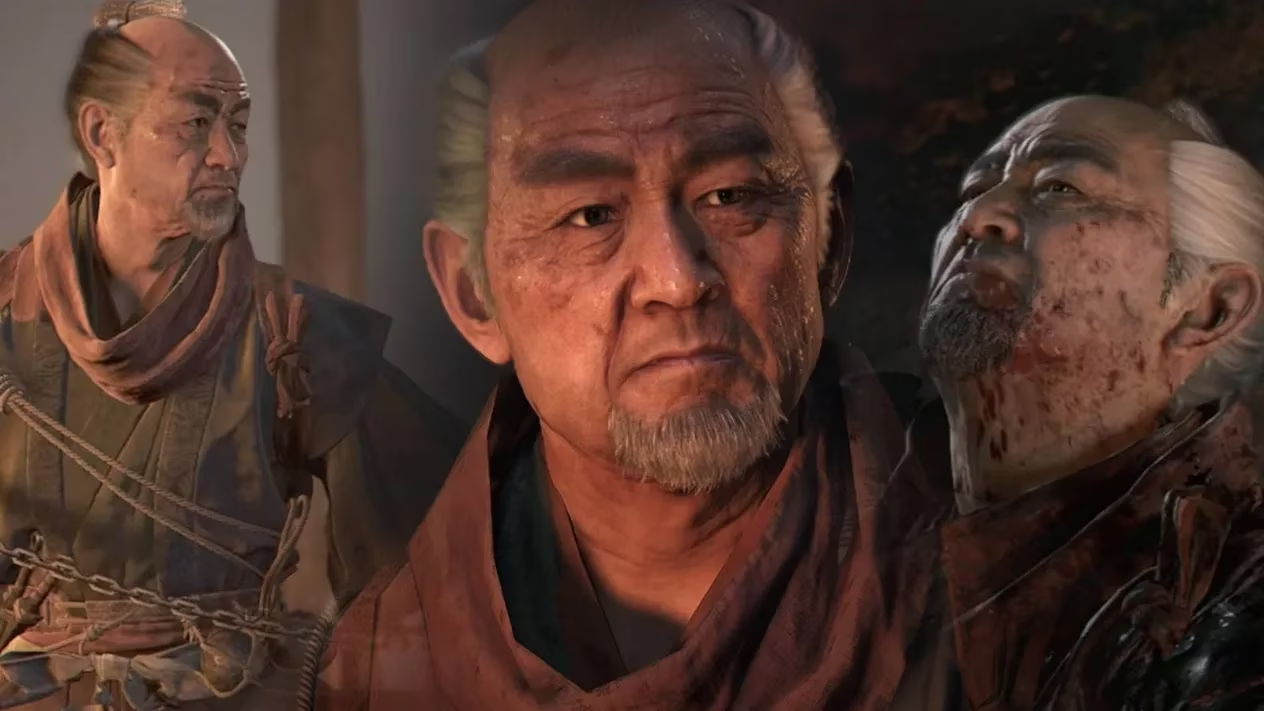
Who Was the Real Momochi Sandayu?
Let’s start with the historical figure, because honestly, the real story is almost more elusive than the game’s version. Historians can’t even agree on his birth year—some say 1512, others push it as late as 1525. But everyone agrees on one thing: Momochi Sandayu was a pivotal leader in Iga Province, a man whose guerrilla tactics would later become the stuff of ninja legend.
Back in 1579, Oda Nobunaga was busy trying to unify Japan, and Iga wasn’t having any of it. Nobunaga sent his son, Oda Nobukatsu, with a formidable army to crush the resistance. According to most accounts, it was Momochi Sandayu who led the Igan forces, using hit-and-run tactics, ambushes, and clever misdirection to humble Nobunaga’s troops. Those very tactics would later be described as early ninjutsu—and yes, that’s the same ninjutsu that pop culture has turned into a mystical art form. Sandayu was basically writing the playbook.
But history, like the shadows, is tricky. In 1581, Nobunaga launched a second, far more devastating invasion, and most records claim Momochi Sandayu met his end there. Yet some folk legends whisper that he survived, slipping away from the carnage to live out his days as a simple farmer. Just imagine: the legendary shinobi, tilling soil under an assumed name, his past buried deeper than any hidden blade.
From History to the Brotherhood
In Assassin’s Creed Shadows, the developers take these historical fragments and craft a version of Momochi Sandayu that feels both authentic and deeply cinematic. Here, he’s a fully-fledged member of the Kakushiba ikki, the Japanese Brotherhood of Assassins. He fights alongside Nagato and Tsuyu—Naoe’s parents—and works closely with another name you might recognize: Hattori Hanzo.
What’s beautiful about the game’s approach is how it doesn’t just dump this information on you in a codex entry. You meet Sandayu through Naoe’s eyes, and that first encounter is nothing short of electrifying. She’s rushing to defend her village from Oda Nobukatsu’s invasion, still raw and untested. She catches Sandayu’s attention by doing the one thing that proves a shinobi’s worth in that moment—killing a samurai. Right there, on the spot, she’s taken under his wing.
Over the next few years, Sandayu becomes the kind of mentor you wish you had in every game. He teaches Naoe far more than how to press the stealth button. Stealth, observation, subterfuge—these aren’t just game mechanics when Sandayu is the one explaining them. He gifts her a grappling hook, too, which becomes one of the most satisfying traversal tools in recent memory. Every time you swing across a castle rooftop, you’re tracing a line back to his training.
A Death That Echoes
Games often struggle with mentor deaths—they can feel cheap or overly scripted. But Momochi Sandayu’s end hits differently. Just like in the historical consensus, he falls during the second invasion of Iga in 1581. However, the game adds a brutal twist: he’s cut down not by some faceless soldier, but by Yasuke, the very person you might later play as. That narrative choice is bold. It connects the two protagonists in a shared, painful history, and it gives Naoe’s revenge arc a personal, burning intensity.
When you look at the real Momochi Sandayu’s fragmented legacy, there’s something poetic about how the game treats him. The man who may or may not have survived becomes, in this story, a martyr whose teachings live on through Naoe. Every stealth kill, every hidden passage she uncovers, is a quiet tribute to her teacher.
Why It All Matters in 2026
We’re now a couple of years removed from the game’s initial release, and the community keeps uncovering fresh layers. Players have combed through the Iga regions, matching landmarks to debated historical sites, discussing whether Sandayu’s portrayal is closer to legend or fact. That’s the magic of Assassin’s Creed Shadows—it respects the ambiguity of real history while delivering a narrative so compelling that you can’t help but dig deeper.
So, next time you activate eagle vision in a dense bamboo forest or grapple onto a pagoda, remember the shadow that started it all. Momochi Sandayu wasn’t just a historical cameo; he was the quiet, weathered heart of Naoe’s origin story. And in a franchise that has seen everyone from Leonardo da Vinci to Blackbeard walk on screen, that’s really saying something.