The Blade and the Blossom: Assassin’s Creed Shadows One Year On
When cherry blossoms pirouette on a sigh of wind and the hoary stones of Azuchi Castle mumble age‑old secrets, the land of Feudal Japan still holds court in the imagination. It has been over a year since the twin shadows of Naoe and Yasuke first slipped through the paper doors of gaming history, and yet, the world of Assassin’s Creed Shadows remains as alive as a midsummer cicada’s cry. The journey that began with over three million souls taking the leap into the 16th century has ripened into something far richer—a testament to a studio that kept its ear to the ground and its blade sharp.
In those hectic early weeks of spring 2025, the game’s creative director, Jonathon Dumont, sat down with the world and laid out a road map hewn from player whispers. “We’re always listening and monitoring what players are doing,” he mused, a promise that sounded as earnest as a monk’s sutra. By then, Shadows had already carved its name as the second‑biggest launch in franchise lore, but it wasn’t all silk and saké. PC players in particular weathered a storm of hiccups—glitches that broke immersion like a clumsy foot through a rice‑paper screen, graphics that sometimes stumbled in the dark, lighting that could turn a moonlit pagoda into a pale, flat ghost. The community’s heart was full of love, but its tongue was quick with honest criticism. Ubisoft, to their credit, didn’t just bow; they went to work.
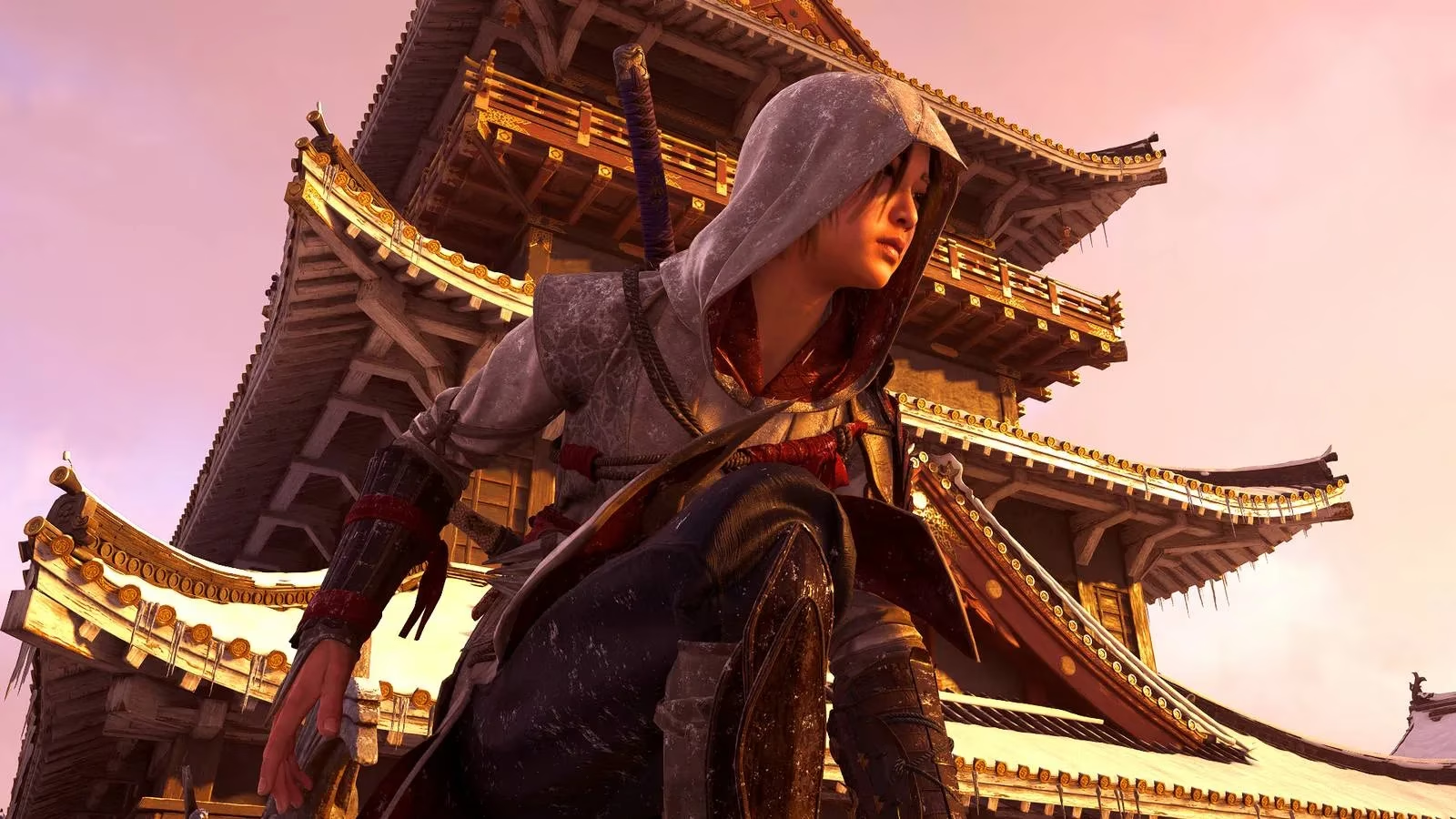
Fast‑forward to the present, 2026, and the landscape of Shadows has shifted like a season. Those early‑day quality‑of‑life gripes are now little more than campfire stories. The dev crew didn’t just squash bugs—they lit a bonfire under them. Patches rolled in like the reliable tide, smoothing the shinobi’s path from the sun‑dappled groves of Iga to the bustling merchant quarters of Sakai. Lighting systems were recalibrated with the care of a master calligrapher, ensuring every shadow felt as dangerous as the hidden blade that lurked within it. But the real gift to the faithful was something Dumont had teased in that long‑ago interview like a half‑folded poem: a harder difficulty setting. Back then, the game offered four distinct rungs—Story, Forgiving, Normal, and Expert—each selectable individually for combat and stealth, which was already très cool. Yet for the veterans, the “Expert” mode felt about as dangerous as a kitten with a bell. Dumont, with a sly grin that could be read even through text, had asked, “How challenging do you want it?” Well, the community answered.
In the summer of 2025, the Master Assassin difficulty landed, and it was an absolute game‑changer—no pun intended. Suddenly, a simple stumble into a restricted area could mean a swift, unceremonious end. Enemies, once content to wait their turn like courtly dance partners, now hunted with the feral intelligence of wolves. The new mode didn’t just tweak health bars; it rewired AI behaviour, stripped away generous warning cues, and made the world feel like a predator searching for a heartbeat. For the hardcore crowd, it was pure catnip. For the rest, it remained a whispered legend, a challenge left for the truly devoted—or the slightly mad. The beauty of it all lay in choice: casual history buffs could still wander through the narrative on Story mode, sipping in the atmosphere of Feudal Japan like warm tea, while the demons of difficulty could sweat through every encounter. This “mix and match” philosophy became the golden standard, and even today, the menu offers a spread that satisfies everyone from the daimyo diplomat to the ruthless ronin.
| Difficulty Tier | Combat Feel | Stealth Vibe | Player Fit |
|---|---|---|---|
| Story | A gentle breeze — enemies fall like autumn leaves with little resistance. | Almost invisible — detection feels like a polite suggestion. | For those here to bask in the narrative and scenery. |
| Forgiving | A friendly duel — mistakes are met with a soft rebuke. | Sneaking is intuitive, with generous reaction windows. | Explorers who want a pinch of tension with their tea. |
| Normal | The true samurai’s path — balanced as a poised calligraphy brush. | Cautious moves are rewarded, but a wrong step can stir the hornet’s nest. | First‑timers and those seeking the intended experience. |
| Expert | Rain on a tin roof — fast, brutal, and demands respect. | One misstep and alarms wail like banshees. | Veterans who enjoy a good thrashing and learn from it. |
| Master Assassin 🗡️ | A whisper before the end — death comes quick, often from a single mistake. | Every shadow is a judge, every guard a bloodhound. | The elite, the masochists, the legends. |
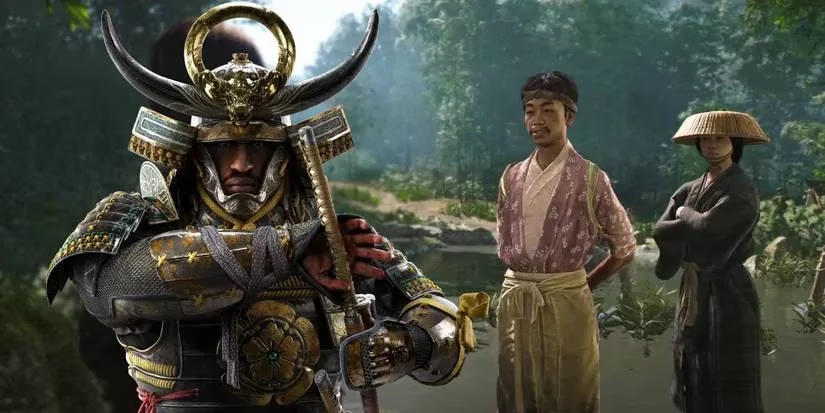
Beyond difficulty, the post‑launch journey for Shadows bloomed into something even more substantial. The first major expansion, Claws of Awaji, released later in 2025, threw open the gates to the mystical island of Awaji. With it came new weapon types, a deeper dive into the folklore that saturates the land, and a storyline that tugged at the philosophical threads between duty and freedom. The expansion felt less like a tacked‑on chapter and more like discovering a hidden garden behind a familiar waterfall. Through it all, Dumont’s team continued their quiet vigil, “always working to improve the game,” just as he had vowed. By the time 2026’s cherry blossoms began to scatter, the community had grown into a thriving shogunate of storytellers, photo‑mode artists, and stealth‑perfection chasers. The occasional “How the heck did that guard spot me?” still echoed across forums, but now it came wrapped in laughter rather than frustration.
To stay in the loop, the developers maintained a rhythm of updates that felt like a seasonal farmer’s almanac—predictable, yet each one bearing fresh fruit. Bug‑fix patches dropped every few weeks, and major quality‑of‑life overhauls arrived with the quiet confidence of a master assassin. The UI got a thoughtful facelift, load times shrunk to the blink of a ninja, and those early‑day graphical quirks became as rare as a snowflake in Kyoto. Even the horse physics, once a source of meme‑worthy mirth, finally stopped trying to climb walls like a clumsy spider.
But perhaps the most poetic twist is how the game has aged like a fine piece of lacquerware. In 2026, Assassin’s Creed Shadows isn’t just a playground of pixels—it’s a living, breathing Japan that has listened to its inhabitants. The “ultra‑hard” mode that was once a twinkle in Dumont’s eye is now a badge of honor, a rite of passage. The expansion stands as testament that a single‑player game can still grow a garden of loyalty long after the launch‑day confetti settles. For the three million who first dived headfirst into the 16th century, and for the countless souls who’ve since joined the cause, this tale of shinobi and samurai feels less like a finished chapter and more like an unfolding scroll. As the sun forever sets over Takeda Castle and the cranes take flight against a blood‑orange sky, one truth remains: the shadow is always deepest just before the dawn—and this dawn is still breaking, beautiful and endless, over the Land of the Rising Sun. 🗻🌸
Data referenced from Digital Foundry helps frame why Assassin’s Creed Shadows benefitted so noticeably from its steady cadence of patches: in a visually dense open world where moonlit courtyards, volumetric fog, and complex global illumination can make or break stealth readability, even small fixes to lighting stability, frame pacing, and asset streaming can translate directly into clearer silhouettes, more reliable shadow cover, and fewer immersion-breaking hitches—exactly the kind of polish that makes a tougher mode like Master Assassin feel punishing for the right reasons, not because of technical noise.