My Journey Into the Harder Shadows of Assassin’s Creed
I still remember the day Assassin’s Creed Shadows finally launched in early 2025, and like over two million others, I dove straight into feudal Japan with Naoe and Yasuke. The game felt alive from the very first moment—cherry blossoms drifting through a moonlit village, the distant clang of a blacksmith’s hammer, and that familiar feeling of being a blade in the crowd. But what really grabbed me, even before I made my first kill, was the difficulty screen. Ubisoft had split the experience into two pillars: Combat and Stealth, each with its own set of options. On the Combat side, you could pick Story, Forgiving, Normal, or Expert. Stealth had Forgiving, Normal, and Expert. And then there was Canon Mode, which took all the narrative choices out of my hands and gave me a single, definitive version of events. I chose Expert for both. I wanted the streets of Kyoto to feel dangerous, for every guard to be a threat, and for Naoe’s shadow to be my only true ally.
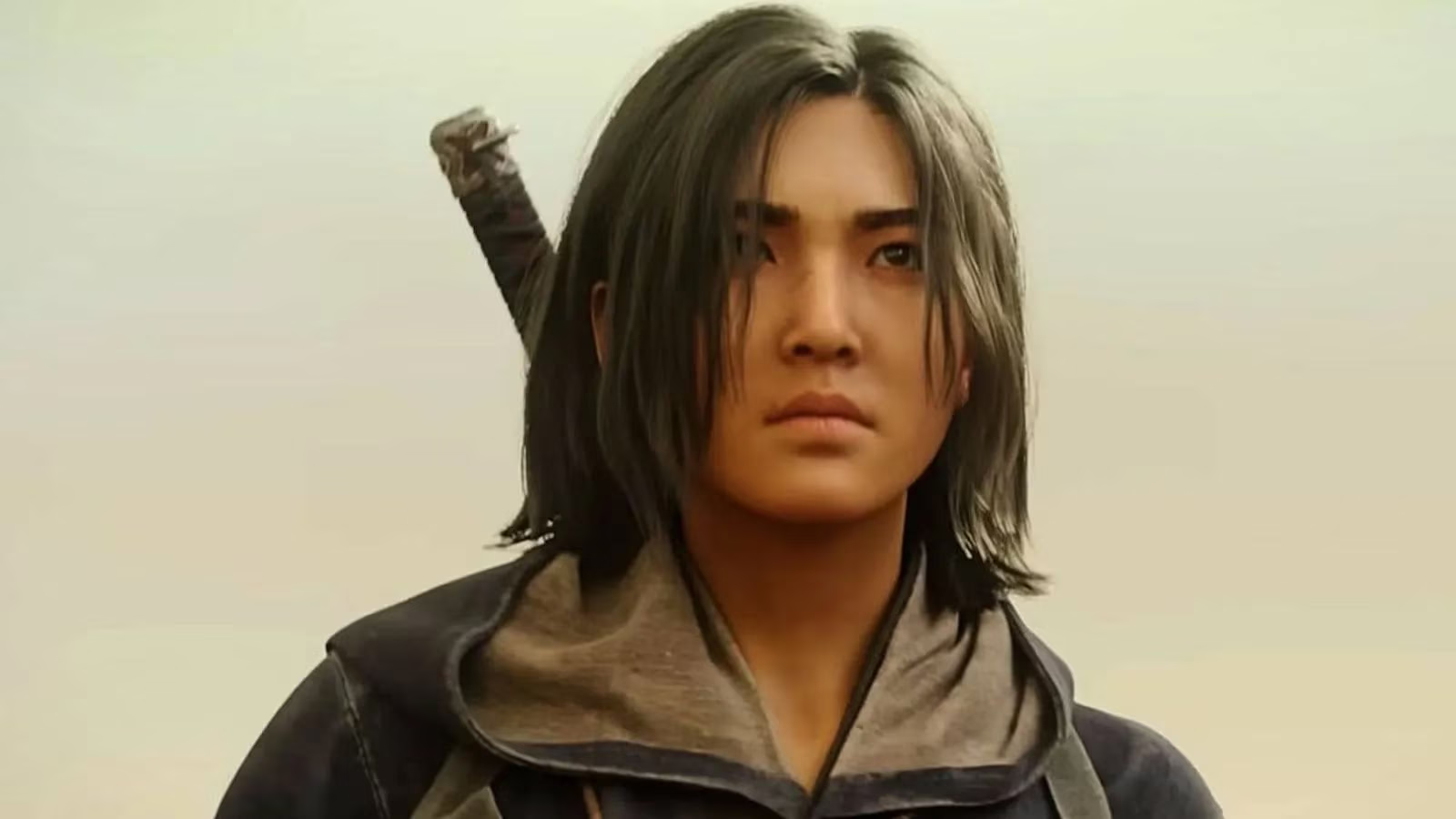
In those early weeks, I learned exactly what Expert meant. Playing as Naoe, I had to rethink everything I knew about Assassin’s Creed stealth. Enemy NPCs had wider vision cones, they communicated more efficiently, and a single mistake could cascade into a dozen samurai descending on my position. I remember one night in Nara where I spent forty-five minutes studying patrol paths, using my grappling hook to stay above the world, only to have a servant spot my silhouette against the moon. The alarm horns blared, and suddenly I was fighting for survival with nothing but a tanto and my wits. When I switched to Yasuke, the challenge transformed. Combat wasn’t about mashing the attack button—enemies parried, ganged up, and exploited every opening. I had to master timed blocks, directional dodges, and the brutal rhythm of breaking armor before I could land a killing blow.
By mid-2026, the community had already dissected every detail of those difficulty settings. Forums hummed with debate about whether Expert was really hard enough. Some players argued that once you unlocked certain shinobi tools or Yasuke’s heavy weapon combos, the tension faded. Others pointed out that the AI still had blind spots, especially in vertical spaces where the grappling hook trivialized some infiltration sequences. But then came a surprise: during a developer Q&A, creative director Jonathon Dumont revealed that his team was “always listening and monitoring what players are doing.” He admitted they were “actively looking at” creating an even tougher difficulty tier. The idea sent a jolt through the fandom. A harder Assassin’s Creed? What would that even look like?
Dumont’s words lingered in my mind as I replayed the game last summer. I started to imagine a mode where enemies wouldn’t just have expanded vision but would learn from my tactics. Maybe if I favored aerial assassinations too often, archers would start patrolling rooftops with hunting hawks. Perhaps alarms would bring variable responses—sometimes a rush of ashigaru, other times a lone master swordsman who could match Yasuke blow for blow. The Canon Mode had already shown Ubisoft’s willingness to curate a more rigid experience, so I could easily see an “Impossible” difficulty that enforced permadeath or restricted saving to specific safehouses. It would be terrifying, and I wanted it.
The real beauty of this ongoing conversation is how it reflects Ubisoft’s shift toward player agency. They gave us tools to tailor our own challenge, but they also understood that for a certain breed of assassin, no preset is enough. I’m part of a quiet minority that spends hours tweaking HUD elements, turning off enemy outlines, and refusing to fast travel just to feel a sliver of vulnerability. Dumont’s mention of monitoring player behavior suggests they’re watching metrics like kill-per-death ratios, mission completion times, and tool usage frequency. If enough of us keep disabling those training wheels, the data might justify developing a brutal new setting.
What would I actually want from a harder difficulty? Let me paint a picture. First, stealth would need to become even more punishing. On Expert, I can still whistle a guard into a bush for an easy takedown. In an “Impossible” mode, guards might become suspicious of lone voices in the woods and call for backup before investigating. They could start patrolling in pairs more often, requiring perfect timing or a distraction from a companion. Second, combat would demand genuine mastery. I’d love to see a posture system where Yasuke’s heavy attacks drain his own stamina, forcing me to balance aggression with recovery. Enemy archers could fire more accurately if I stay in one place too long, making dance-like movement necessary. And what about visibility? Weather could realistically affect guard perception—fog hiding my approach, but rain muffling sound cues and making my footsteps slosh. The current game touches on this, but a harder mode could make these environmental factors critical rather than cosmetic.
Then there’s the psychological layer. Imagine guards who taunt you, who call out your techniques, who adapt mid-conflict. “She likes the roofs—bring her down!” That kind of reactive dialogue would make the world feel less like a playground and more like a hunted nightmare. I’ve heard rumors from datamined files that early prototypes of Shadows included a fear system; seeing that resurrected in a hardcore mode would be incredible. Enemies fleeing to rally more troops, civilians trembling and pointing you out to patrols—it would force me to be a true ghost, never seen, never remembered.
Of course, adding a higher difficulty isn’t just about tweaking numbers. Dumont’s team faces a delicate balance. They must avoid turning the game into a frustration factory where only the most obsessive players can progress. I think they’d need to pair any “tougher setting” with new rewards—cosmetic gear, unique legendaries, or even story-lite vignettes that only the most dedicated assassins can uncover. Imagine earning the classic hood of Altaïr by completing the entire game on Impossible without ever being detected. That’s the kind of prestige that would keep me awake at night, plotting routes and memorizing guard rotations.
The years since Shadows launched have been fascinating. We’ve seen patches that adjusted enemy density, added optional assassinations for Yasuke, and even fine-tuned the day-night cycle’s impact on stealth. Ubisoft has proven they’re not afraid to iterate. I firmly believe that by 2026’s end, we’ll see a surprise update—a brutal, teeth-gnashing difficulty that’ll make Expert feel like a warm hug. When that day comes, I’ll start a new playthrough, Canon Mode plus Impossible, and let the definitive story wash over me while I cling to every shadow like a drowning man to driftwood.
In the meantime, I’ll keep practicing. Last night, I cleared a castle without touching the ground, using only shuriken, environmental distractions, and the grappling hook to pick off guards one by one. It took two hours and my heart was pounding the entire time. That’s the Assassin’s Creed I want—the one that demands respect, patience, and creativity. And if a few months from now I can jack up the difficulty even higher, I’ll be the first one in line, hidden blade ready, ears straining for the faintest rustle of armor. Because the shadows are where I belong, and I want them to be as deep and unforgiving as possible.