Ghost of Yotei vs. Assassin's Creed Shadows: How Forgiveness Can Elevate a Revenge Story
Another year, another epic set in feudal Japan lands on my screen. As a player, I can't help but feel we're in a golden age for this setting, but with so many titles emerging, the comparisons are inevitable, aren't they? Just a couple of years ago, in 2026, Assassin's Creed Shadows faced intense scrutiny, constantly being measured against the beloved Ghost of Tsushima. Yet, Shadows carved its own path and proved that two great games can share a backdrop without being carbon copies. Now, the spotlight shifts to Sucker Punch's Ghost of Yotei, and I'm already seeing the same cycle begin. Everyone's asking: will it be like Tsushima? Will it be like Shadows? But what if the real question is, what can Yotei learn from its predecessors to tell a truly unforgettable story?
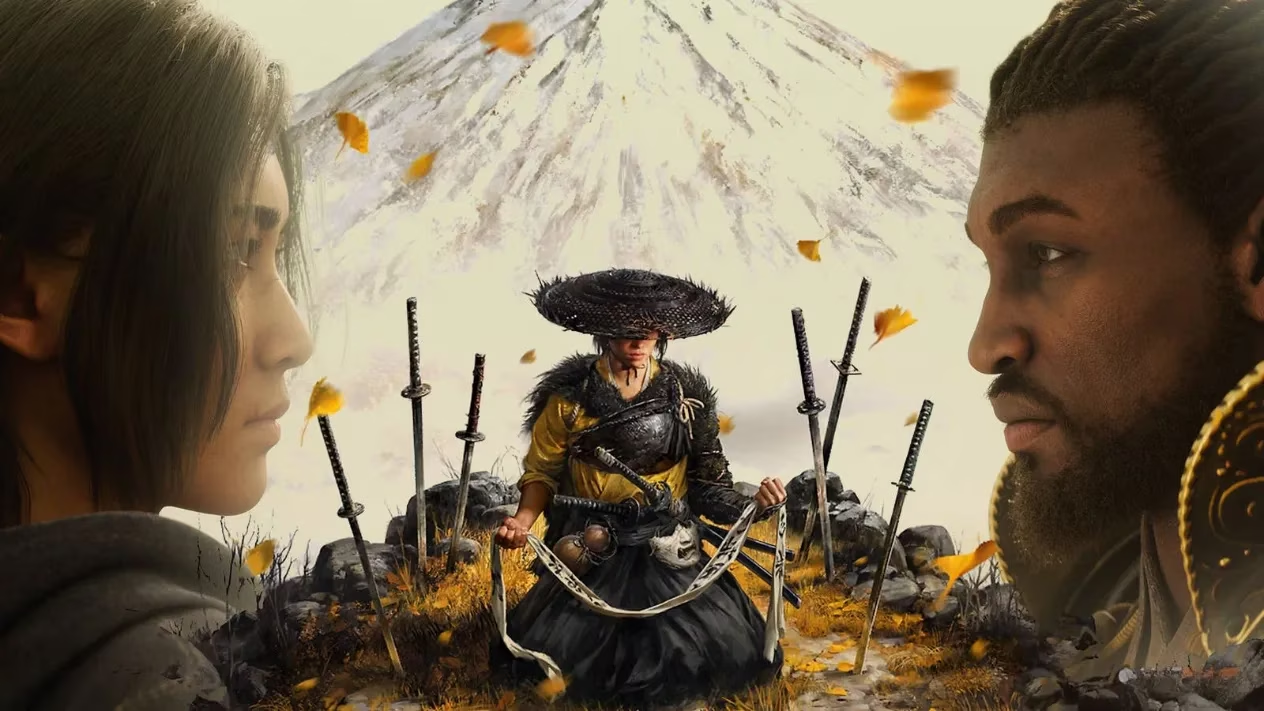
Let's talk about the story we know so far. The core of Ghost of Yotei is a classic, powerful driver: revenge. Our protagonist, Atsu, vows to hunt down those responsible for her family's death. Sounds familiar? It should, because Assassin's Creed Shadows also ran on that very fuel. We had Naoe, driven by the loss of her father, and Yasuke, confronting a painful past tied to the Templars. On the surface, both games seem to be boarding the same train to Vengeance Town. But here's my thought: if Ghost of Yotei wants to avoid being just another revenge tale, it needs to look closely at what made Shadows' narrative resonate. It wasn't just the act of revenge; it was the journey toward something harder: forgiveness.
The One-Dimensional Trap of Pure Revenge
Think about it. When a character's entire existence is defined by 'get the bad guy,' what's left for them to become? The risk is creating a protagonist who is flat, predictable, and emotionally static. Their world becomes black and white—good versus evil—and every action is justified by that singular goal. Where's the internal conflict? Where's the moral questioning? This is the pitfall Ghost of Yotei must skillfully avoid. Atsu's journey could easily become a linear path of destruction if revenge is her only compass.
The Nuance That Forgiveness Brings
Now, let's remember how Assassin's Creed Shadows handled this. Naoe starts with a burning hatred for Yasuke, who served under the man who attacked her village. She wants him dead. But the game introduces a brilliant moment of reflection through Junjiro, who points out her own culpability in his father's death. This wasn't just a plot twist; it was a character-defining choice. Naoe had to confront the weight of her actions and choose to forgive. This theme of forgiveness did something magical:
-
It united the protagonists: It was the bridge that connected Naoe and Yasuke's stories, transforming them from rivals into allies.
-
It added moral complexity: The world stopped being about 'us vs. them.' Characters had to live with their decisions and recognize the cycle of violence.
-
It fueled character growth: The pursuit of vengeance was tempered by the harder, more human struggle to let go and understand.
How Could This Work for Atsu in Ghost of Yotei?
Sucker Punch has already shown mastery with Jin Sakai's arc in Tsushima, where honor and practicality clashed. For Atsu, integrating a theme of forgiveness could be the next evolution. Imagine these possibilities:
1. Introducing a "Mirror" Character: What if Atsu encounters someone who has also suffered loss because of her actions, or the actions of her clan, just as Naoe did? This would force her to see herself not just as a victim, but as a potential agent of pain in someone else's story.
2. Meaningful Player Choice: The game could offer pivotal moments where the player, as Atsu, can choose mercy or vengeance. These wouldn't be simple good/evil buttons but difficult decisions that reshape her relationships and her own self-perception. For example:
| Confrontation Scenario | Vengeance Choice Outcome | Forgiveness Choice Outcome |
|---|---|---|
| Facing a low-ranking soldier | Gains a resource, reinforces her rage. | Gains a reluctant ally or crucial information, but struggles with her resolve. |
| Confronting the main conspirator | Achieves her goal, but feels hollow; the cycle continues. | Spares them, breaking the cycle but creating a powerful, unpredictable enemy for the future. |
3. A Journey of Two Halves: The first half of the game could be Atsu's relentless pursuit, building her skills and fury. The second half could introduce the consequences of that path and present the harder, more mature path of understanding and, potentially, forgiveness. This would mirror a true emotional journey from blindness to clarity.
Ultimately, embracing this complexity would make Atsu a far more compelling character. We would see her not as a weapon of vengeance, but as a human being navigating immense grief and trauma. It would allow players to connect with her on multiple levels—empathizing with her pain, questioning her methods, and hoping for her healing.
So, as we look ahead to Ghost of Yotei, the comparisons to Assassin's Creed Shadows are understandable. But instead of seeing them as rivals, I see an opportunity. Shadows demonstrated that a revenge story is most powerful when it dares to explore what lies beyond revenge. If Ghost of Yotei can weave that thread of forgiveness into Atsu's quest, it won't just be a great successor to Tsushima or a peer to Shadows—it could set a new benchmark for emotional storytelling in action games. The stage is set for Sucker Punch to deliver another masterpiece. Will Atsu's tale be one of endless bloodshed, or one of profound, hard-won humanity? I, for one, can't wait to find out. :japanese_castle: :crossed_swords: :pray: