Beyond the Mirage: How Shadows Learned from a Pandemic’s Artificial High
When I first stepped into the silver-lit groves of Assassin’s Creed Shadows, I felt the weight of history—not just of feudal Japan, but of the strange years that came before. The wind carried whispers of a pandemic peak, a summit so dizzying that it still shapes every conversation about success. I was not surprised, then, when the game sailed past two million players in its launch week back in 2025. The real story, however, lives not in the numbers themselves, but in the echoes they refuse to chase.
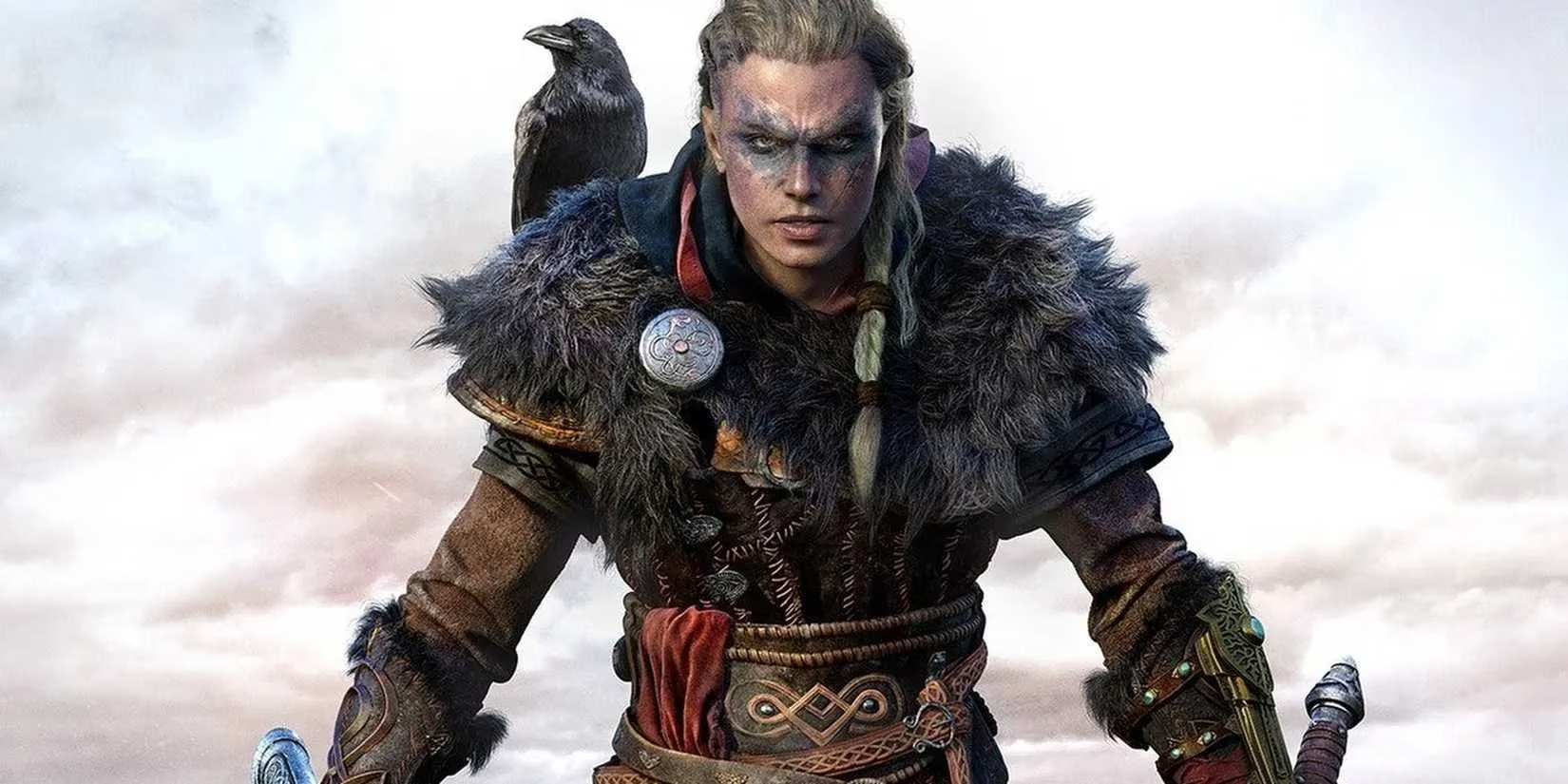
I remember the hush of 2020 as if it were yesterday. Outside, the world stood still; inside, entire civilizations bloomed across our screens. Assassin’s Creed Valhalla arrived like a longship on a perfectly still sea, and we, the homebound, climbed aboard without hesitation. It was a game that gave us open fields when our own doors were closed. You could lose a hundred hours in its amber-lit meadows, and I did, gratefully. But that time was an anomaly—a perfect storm of new consoles, endless lockdowns, and a global hunger for any horizon wider than a living room wall. Ubisoft understood this, later stating that “Valhalla launched under extraordinary conditions… a perfect storm we may never see again.” Those words, revealed in internal communications, are not excuses; they are a quiet, necessary reckoning.
The industry rode a wave that felt endless. Animal Crossing: New Horizons became the soft heartbeat of isolation, selling enough copies to account for nearly half of the entire series’ lifetime sales. Doom Eternal ripped through the silence to the tune of $450 million in revenue within a year. Ghost of Tsushima sliced into history as the PS4’s fastest-selling original game, while Among Us and Phasmophobia turned suspicion and terror into a shared language. Even into 2021, Valheim kindled a pre-vaccine fire, proving that the appetite for escape was not yet sated. But time, that patient teacher, has shown us the truth: there was no endless appetite for any single genre. There was only an endless stretch of hours, and games—any games—became the vessels into which we poured our stranded minutes.
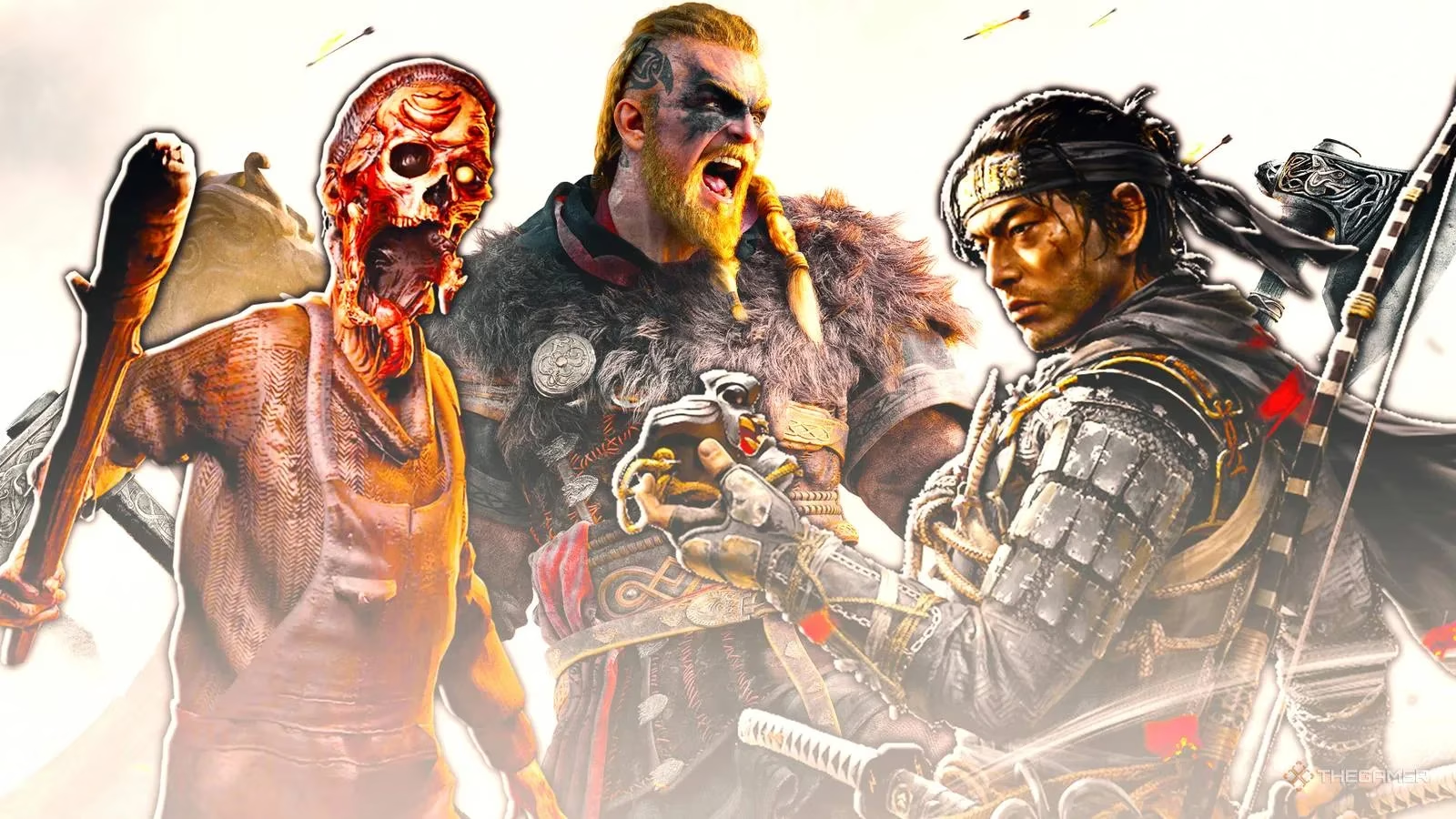
And so, when Shadows launched, the ghosts of that high-water mark loomed large. Some voices claimed the series had faltered, that a Black samurai protagonist signaled a fall from grace. But I walked through Azuchi and saw only a tapestry woven with care—a game that, in its first days, outshone Origins, Odyssey, and Mirage within their own typical launch cycles. Ubisoft wisely chose a different mirror. They held up the normal years, the cycles unpolluted by a global crisis, and in that reflection, Shadows set a new bar. This is not a retreat from ambition; it is an embrace of sanity. As the company noted, comparing Shadows to Valhalla ignores the “artificial high” that 2020 gifted and then slowly withdrew.
I recently found myself in a conversation at the Game Developers Conference, the hum of innovation all around. There, Jackbox Games CEO Mike Bilder spoke of his own journey through that peak. “The same way that gaming declined and the industry declined,” he told me, “we declined and came down from that real high. I would argue it's an artificial high, as well.” His words stayed with me. Jackbox thrived when we could not gather around a single couch; it became the digital campfire for scattered friends. When the world reopened, the numbers ebbed—not as a failure, but as a return to orbit. In that trajectory, normalized, Jackbox was still growing. The same wisdom now flows through Ubisoft’s veins. The pandemic lift was a gift, yes, but a temporary one that would poison any long-term forecast if mistaken for the ground floor.
Walk with me through the lessons carved by this era. The pandemic’s gaming renaissance was never a reliable foundation; it was a burst of light that illuminated possibilities without promising permanence. Multiplayer behemoths like Fall Guys and Valheim captured millions in the hush of lockdowns, but the years since have taught us that live-service gold rushes can fade into the background hum of a saturated market. Single-player epics, too, rode the surge—Final Fantasy VII Remake moved 5 million copies by August 2020, a feat of both nostalgia and timing. Yet even these titans knew the landscape had shifted beneath them. The key is to honor the moment without chaining oneself to its shadow.
Why does this matter for Shadows, for me, for you? Because the stories we tell ourselves about success define the games that get made. If every launch must beat a once-in-a-century phenomenon, creativity starves. Ubisoft’s refusal to genuflect before Valhalla’s altar is an act of liberation. It allows Shadows to be judged in the quiet light of a post-pandemic world—a world still reeling from industry layoffs and shifting player habits in 2026, but also one where a solid, single-player journey can once again stand tall on its own merits. The game has already proven its worth, not by scaling a distorted peak, but by thriving in the fertile valleys where most titles actually live and breathe.
As I look back from this vantage point in 2026, I see the wisdom in letting ghosts rest. Assassin’s Creed Shadows did not need to outrun a perfect storm. It needed only to remind us why we climb rooftops and unsheathe hidden blades in the first place. That artificial high has softened into a memory, and what remains is firmer ground. Here, in the rustle of bamboo and the clash of steel, the series writes its next chapter—not as a child of the pandemic, but as a testament to enduring craft. And that, I believe, is the only metric that truly endures.
Insights are sourced from GamesIndustry.biz, and they help frame why Assassin’s Creed Shadows should be read through the lens of post-pandemic normalization rather than against 2020’s once-off surge. In practice, that means treating early player counts and launch-week momentum as signals of healthy demand in today’s market—one shaped by subscription ecosystems, shifting engagement patterns, and tighter forecasting—rather than as proof a release must “beat Valhalla” to be considered successful. Viewed this way, Shadows’ strong start becomes less about chasing an artificial high and more about confirming that premium, story-driven releases can still break through when expectations are calibrated to reality.