Assassin’s Creed Shadows: I Saw Its Record-Breaking Launch and Sales
I’ve been following Assassin’s Creed launches for years, but the arrival of Assassin’s Creed Shadows in March 2025 felt different. The dual-protagonist setup with Naoe and Yasuke gave me two distinct ways to move through Japan, and thousands of other players clearly shared that excitement. Before long, Ubisoft confirmed that the game had passed a major commercial milestone: it became the second-biggest sales launch in the entire franchise. Even from the outside, the numbers painted a clear picture of a hit, but the reasons behind that success are more specific than I first expected.
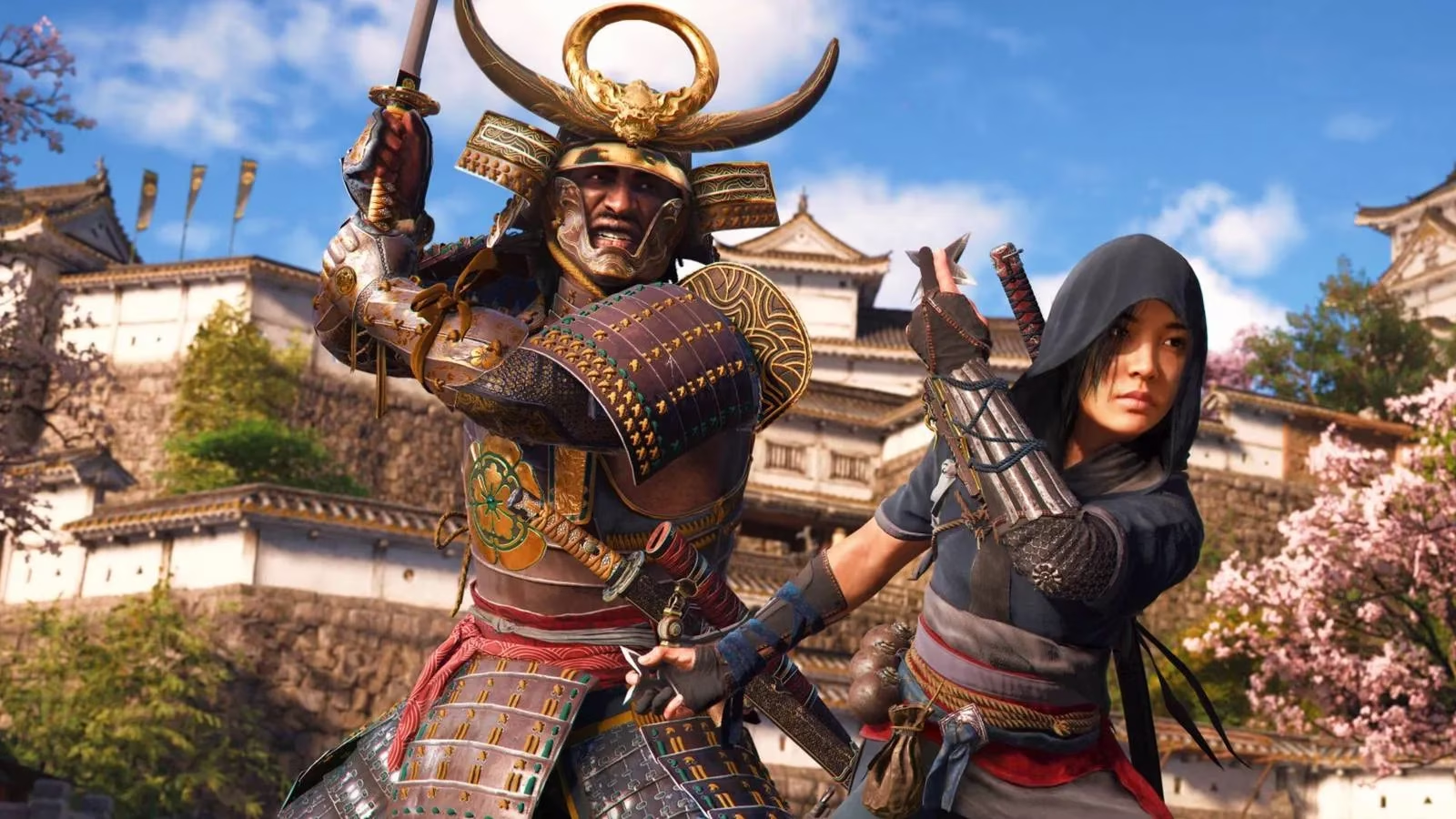
My first clue that Shadows was outperforming expectations came from an internal Ubisoft email reported by IGN. According to that email, Assassin’s Creed Shadows earned the second-highest day-one sales revenue in the history of the series. Only Assassin’s Creed Valhalla managed a bigger launch. That is a massive result when I consider how many Assassin’s Creed games have launched over nearly two decades.
Still, I had to remind myself that player count and sales revenue are not the same thing. Ubisoft previously announced that Shadows reached 2 million players on day one, which is the largest number of players for an Assassin’s Creed launch. However, many of those players accessed the game through Ubisoft+ rather than buying a copy outright. So the exact sales figures may not match that record-breaking player count. The headline might sound a little less dramatic if I focus only on units sold, but the revenue milestone is still very real.
What surprised me most was Ubisoft’s attitude toward comparing Shadows with Valhalla. The company argued that the two launches should not be compared directly. Valhalla launched on both previous-generation and current-generation consoles, which gave it a much larger install base. It also arrived during the COVID-19 pandemic, when stay-at-home orders pushed millions of people toward games. Ubisoft’s internal communication called those conditions “a perfect storm we may never see again.”
That framing made sense to me. Valhalla had a rare combination of hardware reach and global circumstances. Shadows, by contrast, launched in a much more ordinary market environment. Ubisoft pointed to Origins, Odyssey, and Mirage as better comparisons because those games launched in what the publisher called “more typical cycles.” Against those titles, Shadows is already setting a new bar. I think that is a fair way to judge its launch, especially when I look at the timing.
I also noticed something unusual about the release calendar. Assassin’s Creed Shadows launched in March, while nearly every other mainline Assassin’s Creed game has released in October or November. That shift away from the traditional holiday window makes the launch performance even more impressive to me. A March release usually means less crowded holiday spending, but it can also mean fewer immediate blockbuster comparisons.
The PlayStation Store metric stood out as well. IGN reported that Shadows was Ubisoft’s best day-one launch on the PlayStation Store. That is not just an Assassin’s Creed record; it covers all Ubisoft games on that platform. On Steam, Shadows became the most wish-listed Ubisoft game before launch. On Twitch, it was the most watched Assassin’s Creed game ever, surpassing even Valhalla. Those are not random numbers. They suggest the game captured attention across multiple platforms and types of players.
Here is a quick look at the launch metrics that helped convince me this was a major success:
| Metric | Result for Assassin’s Creed Shadows |
|---|---|
| Day-one sales revenue | Second-highest in franchise history |
| Day-one player count | 2 million+, largest AC launch count |
| PlayStation Store day-one | Ubisoft’s best day-one launch |
| Steam wishlists | Most wish-listed Ubisoft game |
| Twitch viewership | Most watched AC game, beating Valhalla |
I think the sales conversation can sometimes get lost in arguments about Ubisoft+ subscriptions or exact unit figures. But the broader pattern is clear: players wanted to experience shadows and blades in feudal Japan. The game offered two protagonists with genuinely different play styles, and that variety gave me a reason to experiment with stealth and direct combat in ways previous entries did not.
From my perspective as someone who has played every major Assassin’s Creed release, Shadows feels like a turning point. The second-highest day-one revenue in franchise history is a big deal. The fact that it happened in March, away from the usual fall window, and without the pandemic boost that helped Valhalla, makes the result stronger. Ubisoft’s internal comparison to Origins, Odyssey, and Mirage is probably the most honest way to measure the game’s launch.
As I look back from 2026, Assassin’s Creed Shadows still stands as one of the most successful launches of 2025. Whether Ubisoft considers it truly profitable will depend on its own long-term metrics, but all the early signals pointed in the right direction. For me, the combination of strong sales, player engagement, and platform records suggests that future Assassin’s Creed games will have a very high bar to clear.