Assassin's Creed Shadows: The Art of a Living Feudal Japan World
When Naoe first slipped through the high grasses of spring, she had no idea that the landscape itself would become one of the most unforgettable characters in her journey. Assassin's Creed Shadows, even in 2026, continues to stand as a masterclass in world-building, not simply because it recreates feudal Japan with painstaking detail, but because that recreation refuses to sit still. Every field, every rooftop, every distant mountain seems to inhale and exhale along with the player.
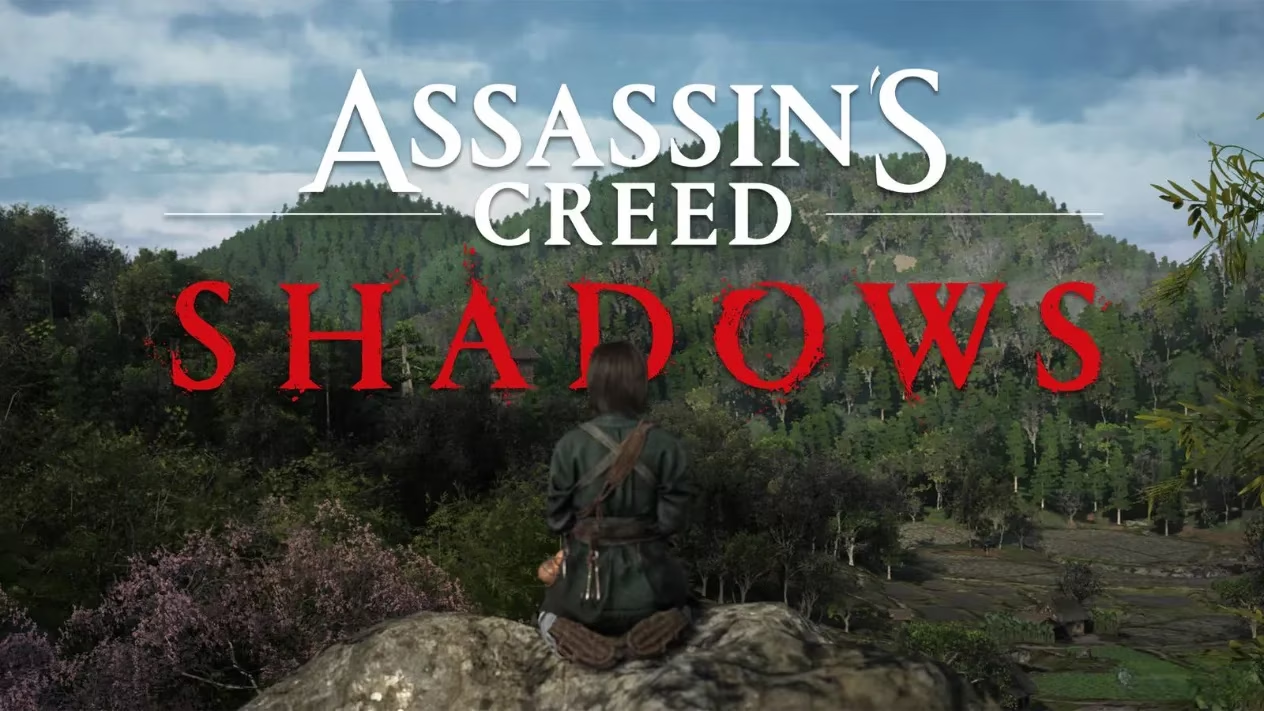
What makes a virtual world feel truly alive? Many open-world games fill their maps with NPCs and wildlife, but few manage to make the environment itself feel like a participant in the story. In Assassin's Creed Shadows, the answer comes through an elegant annual cycle that turns time into a visible, forceful presence. As the months roll by, spring erupts in flourishing flora and towering grasses, offering stealthy shinobi natural hiding places that simply did not exist in winter. How many players have crouched behind a patch of early-spring bamboo, silently thanking the season for its gift? Then summer arrives, with its lush landscapes and bustling agricultural activity. Farmers tend their fields, and the world seems to pulse with daily labor. By autumn, the leaves begin to fall, and those same fields lie harvested. The cover that once shielded a careful approach disappears, forcing a change in tactics. Winter brings snow-covered ground and frozen rivers. A path that was once a simple crossing becomes an icy challenge, and certain stealth routes simply vanish beneath the cold.
| Season | World Changes | Gameplay Impact |
|---|---|---|
| Spring | Flourishing flora, tall grasses | Extra stealth vantage points |
| Summer | Lush landscapes, farming activity | Busier routes, more NPCs |
| Autumn | Falling leaves, harvested fields | Reduced cover, open sightlines |
| Winter | Snow, frozen water | New traversal challenges, fewer stealth options |
This rhythm of seasons is not just cosmetic. It actively reshapes the gameplay loop. A player who thrived in the tall grasses of spring might suddenly find herself exposed in the barren fields of late autumn. The game does not announce these shifts with a tutorial prompt; it simply lets the world change, trusting the player to adapt. Could there be a more honest form of challenge?
Beyond the seasons, the weather systems in Assassin's Creed Shadows add another layer of life. A sudden storm can roll in over the hills, lowering visibility and muffling footsteps. Fog creeps along riverbanks, turning familiar roads into tense corridors of uncertainty. When snow falls during winter, it does not vanish instantly. It lingers, gradually melting under the pale winter sun, and in that slow transition, the world feels real. Wind, too, plays a crucial role. Much like the guiding wind in Ghost of Tsushima, the breeze in Assassin's Creed Shadows bends grass and branches, creating a sense of movement that never truly stops. It is as if the entire province is breathing.
Yet none of this would resonate without the game's remarkable audio and visual design. The ambient sounds of rural Japan—rustling leaves, distant bird calls, the soft crunch of gravel underfoot—anchor the player in the moment. Visually, the attention to detail is staggering. Intricately carved wooden beams, saturated autumn colors, and realistically animated animals all contribute to a world that invites exploration. Why rush toward the next objective when a quiet grove of cherry blossoms is waiting to be admired?
One memorable sequence saw a player begin a contract under the bright green canopy of early summer. By the time she reached the target's stronghold, autumn had stripped the trees bare, and the silent path she had planned was no longer silent. Instead of reloading a save, she adapted—using the falling leaves to time her movements between gusts of wind. That, perhaps, is the real magic of Assassin's Creed Shadows: it does not just ask players to admire its world; it asks them to live in it.
By weaving together evolving seasons, unpredictable weather, and immersive audiovisual craft, Assassin's Creed Shadows delivers a feudal Japan that feels as alive as its protagonists. The setting is not a static backdrop for assassination targets and climbing puzzles. It is a living, breathing partner in every mission, every escape, and every quiet moment of reflection. For players stepping into this world in 2026, the invitation remains the same: stop, look around, and let the world tell its own story.