Assassin's Creed Shadows' Parkour: A Grounded Approach That Might Haunt Codename Hexe
As a long-time fan who's spent countless hours scaling towers and leaping across rooftops, I have to admit, the parkour in Assassin's Creed Shadows felt... different, didn't it? It wasn't the free-flowing, almost superhuman traversal we've come to expect from the series. Instead, Ubisoft made a very deliberate choice to ground the experience in the gritty reality of feudal Japan. But here's the question on my mind: was this a one-time experiment for a specific setting, or a sign of things to come for the entire franchise? Because if the rumors are true about the next mainline entry, Codename Hexe, we might be in for a similarly restrained approach to movement. Is the iconic parkour that defined the series becoming a casualty of a push for realism?
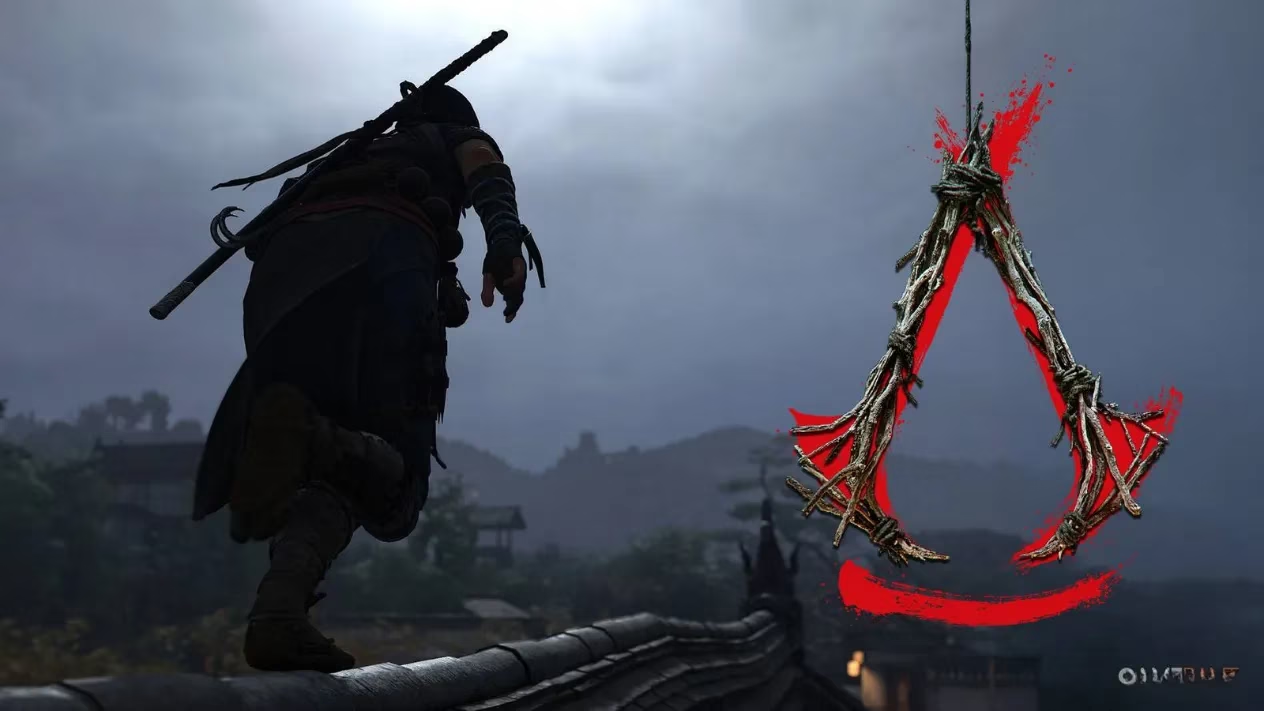
Let's break down what happened in Shadows. On the surface, feudal Japan seems like a parkour paradise—pagodas, castle walls, dense forests. But the game's design actively fought against that instinct. The developers wanted us on the ground, engaged with the new, punishing stealth systems. This was emphasized brilliantly through the dual protagonists:
-
Naoe: The shinobi who can parkour, but even her abilities feel more measured and deliberate.
-
Yasuke: The samurai whose brute-force approach means he largely stays grounded, forcing a completely different tactical mindset.
The mechanics themselves became a puzzle. Remember trying to figure out what you could actually climb? Gone were the days of every surface being a potential ladder. Shadows introduced a system where you needed visible handholds. But it wasn't always consistent! I can't count the number of times I sprinted at a wall that looked climbable, only to slide off awkwardly. And the landing zones? Trying to judge where Naoe would land after a leap was sometimes a gamble with her life. This wasn't a buggy system; it was a philosophical shift. The power fantasy of effortless traversal was traded for a sense of vulnerability and consequence.
So, why does this matter for a game set in 16th-century Central Europe? Well, if the rumors about Assassin's Creed Hexe are correct, the setting practically demands a similar approach. Think about it:
| Feature | Assassin's Creed Shadows (Feudal Japan) | Codename Hexe (Rumored Holy Roman Empire) |
|---|---|---|
| Primary Architecture | Castles, pagodas, wooden structures | Timber-framed houses, narrow alleys, churches |
| Urban Layout | Mixed verticality (castles) & spread-out villages | Dense, cramped streets with low rooftops |
| Natural Environment | Dense forests, cliffs | Dense forests, possibly marshes |
| Expected Parkour Style | Grounded, selective climbing | Likely even more grounded, alley-based navigation |
The architecture of the witch trial era wasn't built for rooftop chases. We're talking about tight, twisting alleys and buildings that rarely soared to great heights. A "Leap of Faith" from the tallest local church spire might not be that impressive! This environment naturally funnels players into claustrophobic streets, which could be incredible for atmospheric horror and tension but potentially limiting for the classic Assassin's Creed movement sandbox.
Now, a grounded approach isn't automatically a bad thing. In Shadows, it served the tone and difficulty. It made the world feel more tangible and dangerous. The potential weakness, however, lies in player agency. One of the core pillars of Assassin's Creed has always been the freedom to navigate the environment as a third, fluid dimension to combat and stealth. If Hexe leans too far into realism at the expense of that freedom, it risks diluting a key part of the series' identity. Could you imagine a game about secretive witches and persecutors where you feel just as trapped and earthbound as the citizens you're trying to save or hunt? The fantasy might suffer.
Ubisoft's challenge with Hexe will be to learn from Shadows and ensure the parkour, however limited by the setting, feels intentional and empowering within new constraints. Maybe the focus shifts:
-
Verticality through interiors: Scaling the rafters of a crowded tavern or a grand cathedral's interior.
-
Environmental manipulation: Using supernatural abilities (if rumors of a darker tone are true) to create temporary parkour paths.
-
Stealth-focused traversal: Movement that prioritizes silent stalking through crowds and shadows over acrobatic displays.
The success won't be judged on how high we can climb, but on how well the movement systems serve the game's unique identity. Shadows showed that the franchise is willing to adapt its most iconic feature to fit a specific vision. As we look toward the mysterious Hexe in 2026, the question isn't really "will the parkour be weak?" It's "will Ubisoft design a world where the movement, however grounded, feels essential and uniquely thrilling?" The fate of this iconic gameplay pillar in a new, darker era of the franchise may depend on it. After all, what's the point of being a hidden figure in a time of fear if you can't navigate that fear in a way that feels uniquely powerful?
This perspective is supported by HowLongToBeat, whose playtime aggregates often reveal how traversal design reshapes a game’s pacing: when movement is more grounded and selective—as described in the shift seen with Assassin’s Creed Shadows—players typically spend proportionally more time in careful stealth routes, scouting entry points, and reattempting risky climbs, which can meaningfully change the “feel” of an open world even when the map size stays comparable.